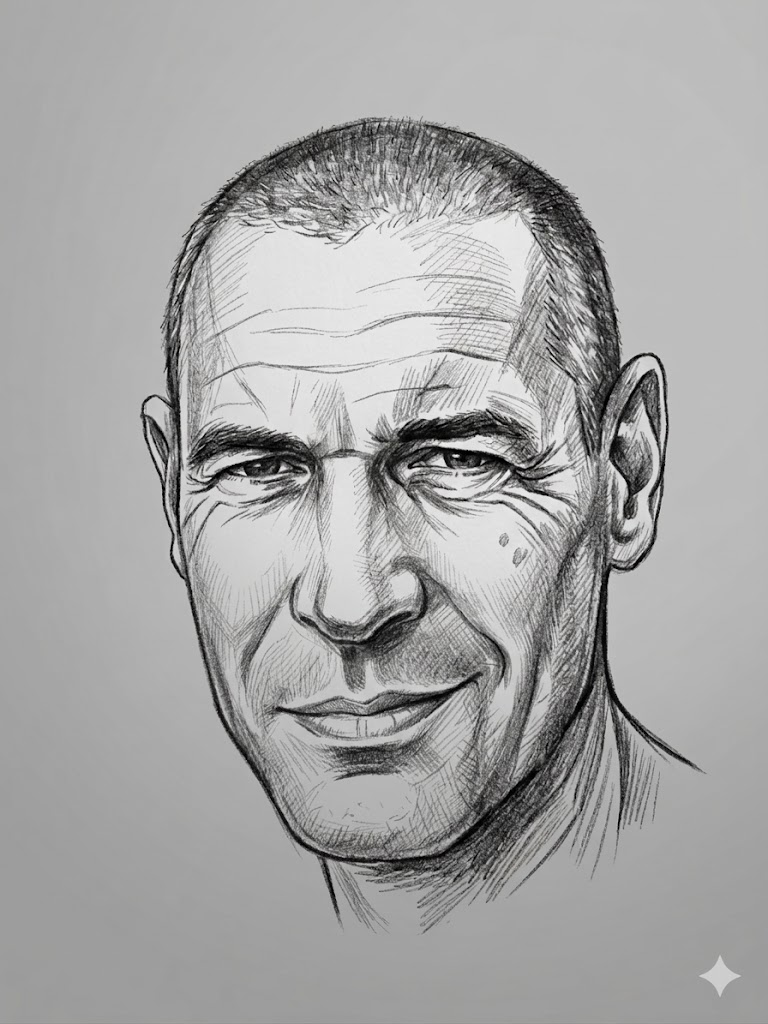
Eldad Haber
Professor & NSERC Industrial Research Chair, University of British Columbia
Computational scientist working at the intersection of inverse problems, machine learning, and the geosciences.
About
I am a Professor in the Department of Earth, Ocean & Atmospheric Sciences and the Institute of Applied Mathematics at UBC, where I hold the NSERC Industrial Research Chair in Computational Geoscience. My work develops computational methods for large-scale problems in science and engineering — from inverse problems and electromagnetic geophysics to modern machine learning. A central thread of my recent research is the view of deep neural networks as dynamical systems governed by ordinary and partial differential equations, which opens a principled path to architectures that are stable, reversible, and interpretable.
What draws me to the ODE/PDE view of deep networks is that it connects a new science — deep learning — to the classical mathematics we already trust. When a network is understood as a discretized dynamical system, its behaviour stops being a black box: that bridge to well-studied theory is, to me, where the explainability of deep networks comes from.
Selected Publications
-
Introduced the dynamical-systems (ODE) view of deep networks, giving a stability theory for training arbitrarily deep architectures.
-
Derived families of convolutional architectures from parabolic and hyperbolic PDEs, connecting network design to well-understood physical models.
-
Used the reversibility of the underlying ODE to build memory-efficient, stable residual networks of essentially unbounded depth.
-
A foundational framework for jointly inverting multiple geophysical data sets by coupling them through shared structure.
Full list on Google Scholar (150+ papers, ~13,800 citations).
Research
Inverse Problems
Large-scale computational inverse problems and optimization for noisy, ill-posed systems.
Deep Learning & PDEs
Viewing neural networks as dynamical systems to design stable, reversible, explainable architectures.
Computational Geophysics
Forward modelling and inversion of electromagnetic and time-domain geophysical surveys.
Machine Learning Applications
Applied ML for imaging, mineral prospectivity mapping, and scientific discovery.
Highlights
- SIAM Fellow (2022) — for contributions to computational inverse problems
- 150+ peer-reviewed publications — ~13,800 citations
- U.S. Department of Energy Career Award recipient
- Co-founder, Computational Geosciences Inc. (2011) & Xtract AI (2017)
- Previously: Schlumberger, and Emory University (Mathematics & Computer Science)